Saturday, April 21, 2007

Theological Dictionary word of the day: Babylonia
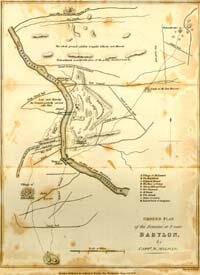
From Travels in Chaldaea, including a journey from Bussorah to Bagdad, Hillah, and Babylon, performed on foot in 1827, published by Henry Colburn and Richard Bentley, London, 1829.Babylonia, named for its capital city, Babylon, was an ancient state in the south part of Mesopotamia (in modern Iraq), combining the territories of Sumer and Akkad. The earliest mention of Babylon can be found in a tablet of the reign of Sargon of Akkad, dating back to the 23rd century BC.

History
Historically, two ethnic groups, the Sumerians and Akkadians, had dominated the region. An area rich in natural resources, and strategically located for trade routes and commerce, it was often under threat from outsiders throughout the region's history.

Old Babylonian period
At around 1900 BC, following the Sumerian revival under Ur-III, Semitic Amorites from west of the Euphrates gained control over most of Mesopotamia. During the first centuries of their rule, Mesopotamia was not unified, and the most powerful city state was Isin. Some Amorites eventually formed a monarchical government in the city-state of Babylon, which would ultimatly take over the Amorite kingdoms and form the first Babylonian empire. The three centuries of their rule is known as the Old Babylonian Period. The Babylonians engaged in regular trade and influence with Western city-states; with Babylonian officials and troops passing to Syria and Canaan. Further, "Amorite" colonists were established in Babylonia for the purposes of trade.


Friday, April 20, 2007

Theological Dictionary word of the day: Assyria
Assyrian EmpireAssyria in earliest historical times referred to a region on the Upper Tigris river, named for its original capital, the ancient city of Assur. Later, as a nation and Empire, it also came to include roughly the northern half of Mesopotamia (the southern half being Babylonia). The capital is Nineveh.

Assyria proper was located in a mountainous region, extending along the Tigris as far as the high Gordiaean or Carduchian mountain range of Armenia, sometimes called the "Mountains of Ashur".

The Assyrian kings controlled a large kingdom at three different times in history. These are called the Old, Middle, and Neo-Assyrian kingdoms, or periods. The most powerful and best-known nation of these periods is the Neo-Assyrian kingdom, 911-612 BC.

More...

Wednesday, April 18, 2007

Theological Dictionary word of the day: Garden of Eden
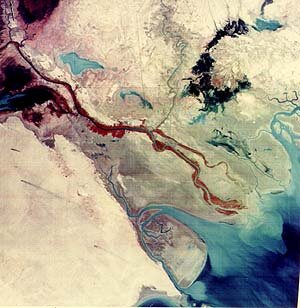
Eden, possibly located in this vecinity where the Tigris and Euphrates terminate into the GulfThe Garden of Eden (from Hebrew Gan Ēden, "גַּן עֵדֶן") is described by the Book of Genesis as being the place where the first man - Adam - and woman - Eve - lived after they were created by God. The past physical existence of this garden forms part of the creation belief of the Abrahamic religions.

The Genesis account (specifically, the Jahwist version of the creation story) supplies the geographical location of Eden in relation to four major rivers. However, because the identification of these rivers has been the subject of much controversy and speculation, a substantial consensus now exists that the knowledge of the location of Eden has been lost.

Suspected locations
There have been a number of claims as to the actual geographic location of the Garden of Eden, though many of these have little or no connection to the text of Genesis. Most put the Garden somewhere in the Middle East near Mesopotamia. Locations as diverse as Ethiopia, Java, Sri Lanka, the Seychelles, Brabant, and Bristol, Florida have all been proposed as locations for the garden. Some Christian theologians believe that the Garden never had a terrestrial existence, but was instead an adjunct to heaven as it became identified with Paradise.

The text asserts that from Eden the river divided into four branches: Hiddekel a.k.a. Tigris, Euphrates, Pishon and Gihon. The identity of the former two are commonly accepted, though the latter two rivers have been the subject of endless argument. But if the Garden of Eden had really been near the sources of the Tigris and the Euphrates, then the original narrators in the land of Canaan would have identified it as located generally in the Taurus Mountains, in Anatolia. Satellite photos reveal two dry riverbeds flowing toward the Persian Gulf near where the Tigris and Euphrates also terminate. While this accounts for four rivers in the vicinity, that area is the mouth of those rivers rather than their source.

More...

Tuesday, April 17, 2007

Theological Dictionary word of the day: Ur
Ur seen across the Royal tombs, with the Great Ziggurat in the background, January 17, 2004Ur was an ancient city in southern Mesopotamia, located near the original mouth of the Euphrates and Tigris rivers on the Persian Gulf and close to Eridu. Because of marine regression, the remains are now well inland in present-day Iraq, south of the Euphrates on its right bank , and named Tell el-Mukayyar, near the city of Nasiriyah south of Baghdad.

6Abram believed the LORD, and he credited it to him as righteousness. 7He also said to him, "I am the LORD, who brought you out of Ur of the Chaldeans to give you this land to take possession of it." 8But Abram said, "O Sovereign LORD, how can I know that I will gain possession of it?" -Genesis 15:6-8

The site is marked by the ruins of a ziggurat (right), still largely intact, and by a settlement mound. The ziggurat is a temple of Nanna, the moon deity in Sumerian mythology.

It has has two stages constructed from brick: in the lower stage the bricks are joined together with bitumen, in the upper stage they are joined with mortar. Ur at its height had around 30,000 residents.

More...

Monday, April 16, 2007

Theological Dictionary word of the day: Euphrates
Tigris and Euphrates Rivers empties through a delta into the Persian Gulf in southeastern IraqThe Euphrates (the traditional Greek name, Arabic: الفرات; Al-Furat, Hebrew: פְּרָת) is the westernmost of the two great rivers that define Mesopotamia (the other being the Tigris).

Etymology
The name Euphrates may have originated from Old Persian Ufratu, as it were from Avestan *hu-perethuua, meaning "good to cross over" (from hu-, meaning "good", and peretu, meaning "ford"). Alternatively, some suggest that the name Euphrates is possibly of Kurdish origin.

Euphrates in the Bible
The river Euphrates is one of the four rivers that flow from the Garden of Eden according to Genesis 2:13-15. It is the fourth river, after the Pishon, the Gihon, and the Tigris, to form from the river flowing out of the garden. The river also marked one of the boundaries of the land promised by God to Abraham and his descendants. In the Hebrew Bible, it is often referred to simply as "The River" (ha-nahar).

The word Euphrates is a translation for the word "Gush forth" or "break forth". It has always been assumed to mean "river" but this is not explicitly stated. It literally means "breaking forth of liquid". The river Euphrates was named from this root word, "To gush forth".
In the Book of Revelation, it is prophesied that in the "near future the Potamos Euphrates or "breaking forth like water" of the middle east will dry up in preparation for the Battle of Armageddon.

More...
African Children.  Taken during Larry and Susan’s 2006 trip to the Eastern Cape of South AfricaTimothy Ministries Easter 2007
Clare Cottage 1724 Crescent Drive Beloit, WI 53511 USA
Phone:(608) 365-7322 Fax:(608) 365-7322
(reposted)


Dear Friends and Partners,

Before we write anything about the missions or ourselves, we wish all of you a blessed and Happy Easter. May you truly find your peace and your satisfaction in the bodily resurrection of Jesus Christ, and in the salvation that He wants to bring to your lives, through your personal faith in Him. That's what makes a really HAPPY EASTER!

When we returned from the overseas last August, we had two giant decisions to make; one had to do with our beloved Shopiere ministry here in Wisconsin and the other had to do with obeying God in funding Timothy Ministries. After months of prayer and searching the Bible, we made both decisions.

On 29 May, we will hand over the work ion Shopiere, WI so we can concentrate more effectively on the Bible Teaching and Revival missions that God has given s in Africa, Europe, and North America. The invitations to other nations and even right here in America are increasing monthly. The Shopiere people are on a solid Biblical footing and have become an exciting mission-hearted congregation. Now, we will be “on the road” even more than in the past. It is as though Timothy Ministries is starting to “rev up” even faster than before.

Concerning the funding of Timothy Ministries, we have always subscribed to the teachings of George Muller, the German minister who cared for over 2000 orphans in the 19th Century England. He said he never asked a man for money… he only asked God. And God put in the hearts of people to support the work that Muller and his wife did among the down-and-out British society. We’ve felt that he was right, that’s why we have tried not to inundate you with financial requests.

Last autumn, several of our partners asked us “What do you specifically need for 2007?” Finally, we made up the “Wish List” with the itemized costs for our work this year. As we write today, 85% of those needs have been met by the generosity and “big hearts” of many of YOU who are reading this letter right now. THANK YOU! THANK YOU! BLESS YOU! We just know that God will finish the job (English carhire & African cell phone) so we will go in June funded at 100%.

The one other project that has been on the “back burner” for three years is buying a used Toyota truck for our mission at Six Trees, South Africa. The time has come for us to do that. We believe God for the remainder of the money before we fly out in June. He knows what is needed and we know God will touch hearts (as He already has just this month) to complete the fund before we head across the ocean once more. We’ve told God! Now, if you’re interested, we’ll tell you. Just ask!

Pray for us. We count on that. We cannot launch a new mission offensive without your prayers. You’ll hear from us, again, right before we go to Africa in June. God loves you…so do we!

-Larry and Sue

Sunday, April 15, 2007

Theological Dictionary word of the day: Mesopotamia
Overview map of ancient MesopotamiaMesopotamia refers to the region now occupied by modern Iraq, eastern Syria, and southern Turkey. The name comes from the Greek words μέσος "between" and ποταμός "river", referring to the area between the Euphrates and the Tigris (the Arabic term is بين نهرين Bayn Nahrain "between two rivers"). The fertile area watered by these two rivers is known as the "Cradle of Civilization," (see also cradle of humanity) and it was here that the first literate societies developed.

The biblical Patriarch Abraham was from Ur in Mesopotamia.


Acts 7:22 To this he replied: "Brothers and fathers, listen to me! The God of glory appeared to our father Abraham while he was still in Mesopotamia, before he lived in Haran.


Genesis 11:28-3128 While his father Terah was still alive, Haran died in Ur of the Chaldeans (see Chaldea), in the land of his birth. 29 Abram and Nahor both married. The name of Abram's wife was Sarai, and the name of Nahor's wife was Milcah; she was the daughter of Haran, the father of both Milcah and Iscah. 30 Now Sarai was barren; she had no children. 31 Terah took his son Abram, his grandson Lot son of Haran, and his daughter-in-law Sarai, the wife of his son Abram, and together they set out from Ur of the Chaldeans to go to Canaan. But when they came to Haran, they settled there.


More...

Saturday, April 14, 2007

Theological Dictionary word of the day: covenant
Rainbow by bluemist57, Adelaide, Australia Covenant, meaning a solemn contract, is the customary word used to translate the Hebrew word berith (ברית) as it is used in the Hebrew Bible
God's promise to Israel in both the Old Testament and the New Testament that He would redeem the nation of Israel, give Israel the land of Zion, and "appear in his glory" and "come out of Zion" when "all Israel shall be saved" (cf. Psalm 102:15-18, Romans 11:25-27).
While the word is used to identify treaties or similar contracts between rulers or individuals, the primary covenants mentioned in the Bible are the one between God and the Israelites (Old Testament) and the one between God and the Christian Church (New Testament).

This covenant was the basis for the Torah, and the claimed status of the Israelites as God's "chosen people." According to the terms of the covenant, Israelites understand that God had promised to undertake certain things on behalf of the people of Israel, and that the Israelites owed God obedience and worship in return.


More...

Friday, April 13, 2007

Theological Dictionary word of the day: Tel Dan Stele
Tel Dan SteleThe Tel Dan Stele is a black basalt stele erected by an Aramaean king in northernmost Israel containing an Aramaic inscription to commemorate his victory over the ancient Hebrews. Although the name of the author of the stele does not seem to appear on the available fragments, it is most likely a king of neighboring Damascus. Language, time, and location make it plausible that the author was Hazael or his son, Bar Hadad II/III, who were kings of Damascus and enemies of the kingdom of Israel. The stele was discovered at Tel Dan, previously named Tell el-Qadi, a mound where a city once stood at the northern tip of Israel . Fragment A was discovered in 1993, and fragments B1 and B2, which fit together, were discovered in 1994.


In the broken part of the stone below the smooth writing surface, there is a possible "internal" fit between fragment A and the assembled fragments B1/B2, but it is uncertain and disputed. If the fit is correct, then the pieces were originally side by side. The inscription has been dated to the 9th or 8th centuries BCE. The 8th-century limit is determined by a destruction layer caused by a well-documented Assyrian conquest in 733/732 BCE. Because that destruction layer was above the layer in which the stele fragments were found, it is clear that it took place after the stele had been erected, then broken into pieces which were later used in a construction project at Tel Dan, presumably by Hebrew builders. It is difficult to discern how long before that Assyrian conquest these earlier events took place.

More...

Wednesday, April 11, 2007

Theological Dictionary word of the day: Tribes of Israel
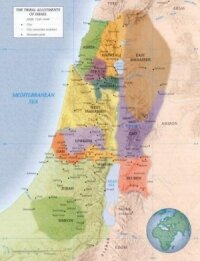
Map of the twelve tribes of IsraelIsrael had 12 sons, as follows: Reuben, Simeon, Levi, Judah, Dan, Naphtali, Gad, Asher, Issachar, Zebulun, Joseph, and Benjamin. (Jacob was renamed Israel Gen. 32:27-29) The Tribe of Levi was set apart from the others in the sense that, the members of the Tribe of Levi were to be in charge of the tabernacle of the Testimony. (see: Num. 1).

The Tribe of Joseph is not usually listed with the Hebrew tribes although Joseph is one of Jacobs twelve sons, the eldest of Rachel. It is sometimes referred to as the House of Joseph. Rather, the two tribes founded by his sons Ephraim and Manasseh are listed separately.


Tribal Divisions
Politically, the Israelites were composed of thirteen tribes: Reuben, Simeon, Levi, Judah, Dan, Naphtali, Gad, Asher, Issachar, Zebulun, Manasseh, Ephraim, and Benjamin. In parts of the Bible, Ephraim and Manasseh are treated as together constituting the House of Joseph, while the Levi have a special religious role and had only scattered cities as territory; whence traditionally either Ephraim and Manasseh were counted as one tribe, or Levi wasn't counted, so that together the tribes were the Twelve Tribes of Israel.

More...

Theological Dictionary word of the day: Tabernackle
The Tabernacle (Reconstruction)The tabernacle (Exodus 25:8-10, 26:1-3) is known in Hebrew as the mishkan ("place of [divine] dwelling"). It was to be a portable central place of worship for the children of Israel from the time they left ancient Egypt following the exodus, through the time of the book of Judges when they were engaged in conquering the land of Canaan, until the time its elements were made part of the final temple in Jerusalem about the 10th century BC.

Hebrew mishkan

The Hebrew word, however, points to a different meaning. Mishkan is related to the Hebrew word to "dwell", "rest", or "to live in", referring to the "[In-dwelling] Presence of God", the Shekhina (or Shechina) (based on the same Hebrew root word as Mishkan), that dwelled or rested within this divinely ordained mysterious structure.


More...

Monday, April 09, 2007

Book of IsaiahBooks of the Old Testament referred to as "the prophets":

Former Prophets
Joshua or Yehoshua [יהושע]
Judges or Shoftim [שופטים]
Samuel or Shmu'el [שמואל]
Kings or Melakhim [מלכים]

Latter Prophets

Major Prophets
Isaiah or Yeshayahu [ישעיהו]
Jeremiah or Yirmiyahu [ירמיהו]
Lamentations [מגילת איכה]
Ezekiel or Yehezq'el [יחזקאל]
Daniel

Minor Prophets
Trei Asar (The Twelve Minor Prophets) תרי עשר
Hosea or Hoshea [הושע]
Joel or Yo'el [יואל]
Amos [עמוס]
Obadiah or Ovadyah [עבדיה]
Jonah or Yonah [יונה]
Micah or Mikhah [מיכה]
Nahum or Nachum [נחום]
Habakkuk or Habaquq [חבקוק]
Zephaniah or Tsefania [צפניה]
Haggai or Haggai [חגי]
Zechariah Zekharia [זכריה]
Malachi or Malakhi [מלאכי]

More...
A Sefer Torah opened for liturgical use in a synagogue service Torah (תּוֹרָה) is a Hebrew word meaning "teaching," "instruction," or "law." It is the central and most important document of Judaism revered by Jews through the ages. It is written in Hebrew, the oldest Jewish language. It is also called the Law of Moses (Torat Moshe תּוֹרַת־מֹשֶׁה).

Torah primarily refers to the first section of the Tanakh–the first five books of the Hebrew Bible, but the term is sometimes also used in the general sense to also include both of Judaism's written law and oral law, encompassing the entire spectrum of authoritative Jewish religious teachings throughout history, including the Mishnah, the Talmud, the Midrash, and more.

The five books and their names and pronunciations in original Hebrew are as follows:


  1. Genesis (בראשית, Bereshit: "In the beginning...")
  2. Exodus (שמות, Shemot: "Names")
  3. Leviticus (ויקרא, Vayyiqra: "And he called...")
  4. Numbers (במדבר, Bammidbar: "In the wilderness..."), and
  5. Deuteronomy (דברים, Devarim: "Words", or "Discourses")

More...

Sunday, April 08, 2007

Theological Dictionary word of the day: Resurrection of Jesus
The resurrection of Jesus as depicted by Matthias GrünewaldAccording to the Trinitarian interpretation of the New Testament, Jesus was both human and God, so he had the power to lay his life down and to take it up again; thus after Jesus died, he came back to life. This event is referred to in Christian terminology as the resurrection of Jesus Christ, and is commemorated and celebrated by most Christians annually on Easter Sunday.

Most Christians, even those who do not interpret other parts of the Bible literally, accept the New Testament story as an historical account of an actual event central to their faith, though some do not accept a literal bodily resurrection, sometimes arguing for docetism. But it so seems that in the past, a large group of Christians known as the Gnostics, who were later declared heretics and partially exterminated, argued against its singular importance, and claimed that the New Testament supported their claims. Non-Christians generally view the story as legend or as allegory.


The New Testament
The primary accounts of the resurrection are in the last chapters of the Canonical Gospels: Matthew 28, Mark 16, Luke 24, John 20-21.


All the Canonical Gospel accounts agree that Jesus was crucified late on Friday afternoon and placed in a tomb belonging to Joseph of Arimathea. On Sunday, after the Saturday Jewish day of rest, one or more of Jesus' female followers, one or more of whom were called Mary, returned to the tomb, to complete the burial rites. When they arrived they discovered that the tomb was empty, or more accurately it did not contain Jesus' body. They then conversed with (an) angel(s)/male youth who informed them that Jesus was resurrected/not there, and so they departed. According to the traditional ending of Mark 16, and the surviving versions of the other Gospels, the women returned with some of Jesus' disciples to confirm the emptiness of the tomb. However, ancient manuscripts of Mark 16 vary heavily after this point, some ancient manuscripts even halt at this point, and most scholars do not believe the traditional ending was the original one.


More...

Saturday, April 07, 2007

Theological Dictionary word of the day: Joseph of Arimathea
Joseph of ArimatheaJoseph of Arimathea, according to the Gospels, was the man who donated his own prepared tomb for the burial of Jesus after Jesus was crucified. A native of Arimathea, he was apparently a man of wealth, and a member of the Sanhedrin (which is the way bouleutes, literally "senator", is interpreted in Matthew 27:57 and Luke 23:50). Joseph was an "honourable counsellor, who waited (or "was searching" which is not the same thing) for the kingdom of God" (Mark, 15:43). As soon as he heard the news of Jesus' death, he "went in boldly" (literally "having summoned courage, he went") "unto Pilate, and craved the body of Jesus."


Pontius Pilate, who was reassured by a centurion that the death had really taken place, allowed Joseph's request. Joseph immediately purchased fine linen (Mark 15:46) and proceeded to Golgotha to take the body down from the cross. There, assisted by Nicodemus, he took the body and wrapped it in the fine linen, sprinkling it with the myrrh and aloes which Nicodemus had brought (John 19:39).


The body was then conveyed to a new tomb that had been hewn for Joseph himself out of a rock in his garden nearby. There they laid it, in the presence of Mary Magdalene, Mary, the mother of Jesus, and other women, and rolled a great stone to the entrance, and departed (Luke 23:53, 55). This was done speedily, "for the Sabbath was drawing on".


Joseph of Arimathea is venerated as a saint by the Catholic and Eastern Orthodox Churches. His feast-day is March 17 among Latins, and July 31 in the East. He appears in some early New Testament apocrypha, and a series of legends grew around him during the Middle Ages, which tied him to Britain and the Holy Grail.

More...

Thursday, April 05, 2007

Theological Dictionary word of the day: Crucifixion
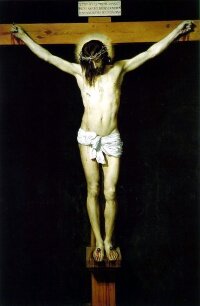
Jesus' crucifixion as portrayed by Diego VelázquezCrucifixion is an ancient method of execution, where the victim was tied or nailed to a large wooden cross and left to hang there until dead. It is mostly widely known as a not uncommon but extremely dishonorable as well as excruciating form of judicial execution in the Roman Empire, though similar methods were employed in other ancient cultures. Crucifixion has special significance in Christianity, which holds that Jesus was crucified but later resurrected. Because of this the Christian cross or crucifix has become a common symbol of Christianity.

Crucifixion was used by the Romans (see Roman Empire) until about 313 AD, when Christianity became the dominant faith in Rome. However, it has been used in various places in modern times.

Details of crucifixion
Crucifixion was rarely performed for ritual or symbolic reasons.
Usually, its purpose was to provide a particularly painful, gruesome, and public death, using whatever means were most expedient for that goal. Widely different crucifixion methods varied considerably with location and time period.


More...
Theological Dictionary word of the day: Jerusalem
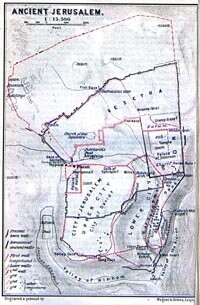
From Palestine and Syria. Handbook for Travellers by Karl Baedeker, 5th Edition, 1912 Jerusalem is the holiest city of Judaism (since the 10th century BCE) and some denominations of Christianity (since the 5th century CE) and, after Mecca and Medina, the third holiest city of Islam (since the 7th century CE). A heterogeneous city, Jerusalem represents a wide range of national, religious, and socioeconomic groups. The section called the "Old City" is surrounded by walls and consists of four quarters: Armenian, Christian, Jewish, and Muslim.

37"O Jerusalem, Jerusalem, you who kill the prophets and stone those sent to you, how often I have longed to gather your children together, as a hen gathers her chicks under her wings, but you were not willing. 38Look, your house is left to you desolate. 39For I tell you, you will not see me again until you say, 'Blessed is he who comes in the name of the Lord.[1]'" -יהושע Yehoshua, Matthew 23:37-39

The status of the united Jerusalem as Israel's capital is not widely recognized by the international community, and Israel's annexation of East Jerusalem is particularly controversial.
Jerusalem has long been embedded into the religious consciousness of the Jewish people. Jews have always studied and personalized the struggle by King David to capture Jerusalem and his desire to build the Jewish temple there, as described in the Book of Samuel and the Book of Psalms. Many of King David's yearnings about Jerusalem have been adapted into popular prayers and songs.


More...

Wednesday, April 04, 2007

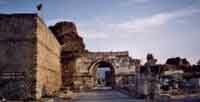
Theological Dictionary word of the day: First Council of Nicaea
The Walls of NicaeaSeparation of Easter from the Jewish Passover
After the June 19 settlement of the most important topic, the question of the date of the Christian Passover (Easter), was brought up. This feast is linked to the Jewish Passover, as crucifixion and resurrection of Jesus occurred during that festival. By the year 300, most Churches had adopted the Western style of celebrating the feast on the Sunday after the Passover, placing the emphasis on the resurrection, which occurred on a Sunday. Others however celebrated the feast on the 14th of the Jewish month Nisan, the date of the crucifixion according to the Bible's Hebrew calendar. Hence this group was called Quartodecimans. The Eastern Churches of Syria, Cilicia, and Mesopotamia determined the date of Christian Passover in relation to the 14th day of Nisan, in the Bible's Hebrew calendar. Alexandria and Rome, however, followed a different calculation, attributed to Pope Soter, so that Christian Passover would never coincide with the Jewish observance and decided in favour of celebrating on the first Sunday after the first full moon following the vernal equinox, independently of the Bible's Hebrew calendar.

More...

Tuesday, April 03, 2007

Theological Dictionary word of the day: Passion
Christ with the crown of thorns, 1623, Oil on canvas, 106 cm x 136 cm, Catharijneconvent, UtrechtThe Passion is the theological term used for the sufferings of Christ, especially in the agony of the Garden of Gethsemane and on the cross. (see crucifixion). The Crucifixion is an event central to Christian beliefs.

The etymological origins of the word lie in the Christian Latin passus, (stemming from pati, patior- to suffer) and first appearing in the 2nd century precisely to describe the travails and suffering of Jesus in this present context. The word passion has since taken on a more general application. The term the Agony of Jesus is sometimes used alternately, although is generally more specifically applied to Jesus' agony of mind while praying before his arrest: the Agony in the Garden [of Gethsemane].

Those parts of the four Gospels that describe these events are known as The "Passion narratives". The non-canonical Gospel of Peter is also a Passion narrative.

More...

Monday, April 02, 2007

Theological Dictionary word of the day: Passover
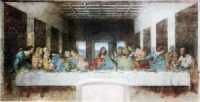
The Last Supper fresco in Milan (1498)  by Leonardo da VinciPassover (Hebrew: פסח; transliterated as Pesach or Pesah), also called חג המצות (Chag HaMatzot - Festival of Matzot) is a Jewish holiday beginning on the 15th day of Nisan, which falls in the early spring and commemorates the Exodus and freedom of the Israelites from ancient Egypt. Passover marks the "birth" of the Jewish nation, as the Jews were freed from being slaves of Pharaoh and allowed to become servants of God instead.

In most languages of Christian societies, other than English, German and some Slavic languages, the holiday's name is derived from Pesach, the Hebrew name of Passover, a Jewish holiday to which the Christian Easter is intimately linked.

Together with Sukkot and Shavuot, Passover is one of the three pilgrim festivals (Shalosh Regalim) during which the entire Jewish populace made a pilgrimage to Jerusalem in the days of the Holy Temple.

In Israel, Passover is a 7-day holiday, with the first and last days celebrated as a full festival (involving abstention from work, special prayer services and holiday meals). Outside Israel, the holiday is celebrated for 8 days, with the first two days and last two days celebrated as full festivals. The intervening days are known as Chol HaMoed (festival weekdays).

more...