Tuesday, March 18, 2008

Dear Timothy Family,

Greetings! If you had to miss the Saturday meeting due to family situations, travel, and/or ministry and mission responsibilities, I wanted to bring you up-to-date concerning decisions and plans for the future with Timothy Ministries.

  1. Our current USA Treasury (Dick Thompson) had approximately $34,000 as of 14 March, 2008. And, our UK Treasury (Lesley Robinson) had about 2200 Pounds or
    $4400 in it. We are solvent and praising God for His provision.
  2. Current Involvements for March include officiating at the wedding of Rob Tust and
    Jodi Dunham in Elkhorn, WI..... a young couple who met on a Timothy mission trip to Frodsham, England. (Timothy Ministries has even "planted" a new family!!! :>) Philip
    Allen will represent Timothy Ministries at the Annual Meeting of the Northern Illinois Fellowship of the CCCC, in Chicago. And, Larry & Sue Correll will speak at the Winneconne Christian Fellowship on 5-6 April.
  3. To honor the ministry of Tom Amundson (one of our dedicated workers who died of cancer in February), those here established a Short-term Mission Scholarship Fundto assist applicants who need help with funding for short-term trips, here or abroad. We allocated a total of $2008 for this year, $2009 for next year, and $2010 for the following year... to be awarded to any number of American local church applicants who meet these criteria:
    • have a testimony of a born-again relationship with Jesus Christ, and an ability to express why they are going on a short-term mission trip.
    • are going with a church and/or mission organisation that is Bible-based and Christ-centred, and have a legitimate reference from their pastor and/or mission director.
    • that the main emphasis of the short-term trip is evangelistic.
    • that the applicant has made legitimate attempts to raise funds and still has a need for money to get to 100% of the cost of the trip.
      We have sent out notices to our supporting churches & representative donors stating that potential applicants should contact Rudy and Marty Zuniga. They are our contact people for administering Scholarships and are working with our evaluation group (Joe Correll, Philip Allen, Doug Gearhart, and Jean DiBenardo). We hope to be able to quietly help Christians serve their Lord in short-term mission for the next 3 years.
  4. Future plans for mission trips include:
    • 28 March-7 April...Joe Correll in Uruguay, building a YFC Training Centre. We contributed $800 for his contingency fund (tools, construction supplies, food, travel, as needed).
    • 8 April-5 October...Larry & Sue in California, assisting and teaching a church in crisis, developing leadership and mission for the future. Those here made the decision to continue Larry & Sue's basic salary package (base pay, social security, & ministry expenses) during the 6 month work in CA)
    • 20 October-12 November...Larry & Sue in Belgium, assisting David Doyen in leadership training and laying plans for a massive youth outreach in 2009.
    • 30 December-18 January, 2009...Larry & Sue in Mexico, teaching Mexican pastors and church workers (at the invitation of Indian Trails Mission). We allocated $3000 for ITM to help our own Buck Van Zandt finish construction of the Tabernacle at Naco Bible Training Centre, Naco, Mexico.
    • 27 January-10 March, 2009...Larry & Sue in Africa, teaching at Kum Bible College and at Emmanuel Christian Church, Capetown, leadership training. We allocated a total of $3000 for the support of ECC and its desire to lead in the ministry training of Congolese refugees in Capetown. The money is to be sent in March ($1200), August ($1200), and December ($600) of 2008. KBC needs to be self-sufficient and has other sources of funding, now. Larry will completely hand over leadership of KBC and its associated work by mid-2009. Sue, likewise, will complete her development work at Sizani School at the same time.
    • 11 March-31 December, 2009...Larry & Sue will take a furlough (R & R) during these months, after 42 years of constant ministry and 15 years of travel for world mission on 3 continents. During these months, they will visit partners and donor churches to give updates and extend gratitude for prayers and support. These are the tentaive plans.
  5. THE MOST IMPORTANT THING WE DID ON SATURDAY WAS TO WORSHIP, SING, AND PRAY TOGETHER, BOTH AS WE BEGAN AND AT THE END OF THE BUSINESS MEETING. IT IS THAT COMMITMENT TO GIVE GLORY ONLY TO GOD THROUGH JESUS CHRIST, THAT KEEPS US GOING AND WORKING BY EACH OTHERS' SIDE. WORSHIP & PRAYER WILL ALWAYS BE THE CENTERPIECE OF TIMOTHY MINISTRIES AND HER PEOPLE! Then we ate lunch, together.
  6. Our next annual mission gathering will likely be 25 April, 2009. THANK YOU AND GOD'S BLESSING TO EACH OF YOU WHO WALK WITH US! Philippians 1: 3-6.

    To everyone, our love and thanks,
    Larry

Thursday, March 13, 2008

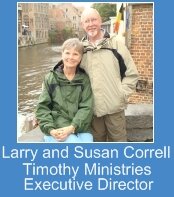
Larry and Susan Correll, Timothy Ministries Executive Director (by the canal in Bruge, Belgium)Dear Friends & Co-workers,

It's that time of year...our annual TIMOTHY MINISTRIES gathering at Clare Cottage, Beloit, WI.

We will meet Saturday, 15 March, at 9:30am ON THE DOT!!! You'll be free by early to mid-afternoon. Here's the agenda (for information & prayer)


  • Prayer & Mini-Worship (no, we're not worshipping Sue's Mini
  • Treasurer's Reports
  • Communications & upcoming church meetings for deputation, etc.
  • Talk about a scholarship to honour Tom Amundson's memory?
  • Future Mission trips (March 2008 through March 2009)?
  • Grant & money allocations for 2008?
  • Thank you's
  • WORSHIP & SHARING IN THE WORD TOGETHER
  • Lunch

If you plan to attend, please let us know you'll be here (& how many) so Sue knows what & how to prepare for lunch. Thanks. We are always excited to open our home and our hearts to all of you. Looking forward, happily, to the 15th.

Together with you, in Jesus,


Larry & Sue

Timothy Ministries
2 Timothy 2: 2
timothyministries.org


Saturday, November 10, 2007

Because of Christ, you can do it!

"Because of Christ, you can do it!"

Autumn of 2007 was a time of great encouragement... God encouraging us in our work preaching and teaching the Word as we tried to be "Barnabas" to churches, pastors and their families, and old friends with whom we've shared ministry for many years. In Cumbria, Warwickshire, and Cheshire, Endland, in Aberdeenshire, Scotland, and in the Sambreville region of Belgium, we saw the gracious hand of God moving in Revival among the churches. It's a funny old thing, that at our age and stage in life, we have been pleased to be used of the Lord to simply say to Christian workers and congregations, "Because of Christ, you can do it!" We look ahead to see what God has in store for us in Europe in 2008. The photo gallery demonstrates the wonderful comradery and effective ministry across western Europe this fall.

Tuesday, October 02, 2007

Joe and Dawn CorrelSouth Africa 2007

Thanks to Missionaries Joe and Dawn Correll

Thanks, Joe and Dawn!

Monday, September 24, 2007

Larry and Susan CorrellTimothy Ministries Autumn 2007

Dear Partners and Friends,

We have returned from Africa. Sue has washed our clothes and repacked our bags. As you read this, we are flying out to Europe and another preaching mission in the churches of England, Scotland, and Belgium. Before Christmas comes, we will also have been able to minister the grace of Jesus Christ in Indiana, Ohio, California, and Wisconsin.

Before we ask for prayer and continued support, may we tell you a little about Africa and give God all the glory for the wonderful ministry we experienced? Teaching the Bible, preaching the Gospel of salvation, and training leaders has grown dramatically this year. We taught 5 college courses at Kum Bible College (for students aiming for graduation in 2008 & 2009). God blessed us with a powerful revival ministry in Six Trees/Lusikisiki District, Konjwaio, Kokstad, and Capetown. God opened the door into a large Christian community of Congolese refugees AND strengthened our work in the Eastern Cape and Kwa-Zulu Natal. Preaching in rondavels and villages, we saw about 70 young people give their lives to Christ as Saviour. We rejoiced to see nearly 200 believers re-dedicate their lives to Jesus. We were in awe as African pastors and elders re-committed their churches and ministries to reach the unsaved with the Gospel. And we were humbled to help plant a new congregation in a poor, out-of-the-way location called Kabajana. Sue was given a good opportunity to work with teachers in both preschools and in a government primary school called Sizani (where the students repair the mud walls of their own classrooms to keep the weather and the animals out!!!) We come home believing that the Holy Spirit has "opened the door" for more vigorous, hard work next year in all these places.

Joe and Dawn Correll and Dr. Philip Allen spent two weeks with us and were a great help in construction, medical outreach, and teaching. In their own individual ways, they learned the realities of cross-cultural mission work, created their own network of friends, and saw the work of the Holy Spirit. They surrendered themselves to personally be God's servants to their African brothers and sisters. That's what genuine mission work is all about! Bless you Joe, Dawn, and Phil; for all that you did with us.

We head across to Europe and then return to ministry in the USA between now and December. We could ask for the usual things like traveling mercies, increased financial support, stamina, good communication, and spiritual wisdom. . .and we do. We beg you to pray for the churches and pastors who have asked us to come serve them in preaching and teaching the Word of God. . .in Storth, Rugby, and Frodsham, Encland; in Aberdeen and Invurary, Soctland; in Auvelais and Dour, Belgium; in Elkhart, Indiana; in Logan, Ohio; in Wasco, California and in Shopiere, Wisconsin. Your steady prayer will undergird our mission and God will bless the places and people where we see Him at work. We believe that!

But, we have an even greater prayer request. Will you please pray that throughout these next few months, we will be changed by the grace of God to, simply, be more like Jesus? That's it. . .we want a continual transformation in our hearts to be like Him. We depend on Christ and we trust you to pray. Thank you! We love you! Talk to you in 3 months.

Thursday, September 06, 2007

Dr. Larry and Susan Correll


Praise God. Larry and Susan Correll have returned safely from their South African trip. Details of the trip will be coming in the next few days.
Theological Dictionary word of the day: Daniel
The prophet Daniel from Michelangelo’s Sistine Chapel ceilingDaniel (Hebrew: דָּנִיֵּאל, Arabic: دانيال, Danyal) is a figure appearing in the Hebrew Bible and the central protagonist of the Book of Daniel. The name "Daniel" means "God is my judge" or "God's judge."

Daniel was a young man of the upper crust of Jewish society who was taken captive by Nebudchadnezzar, king of Babylon and the Chaldean dynasty. Nebudchadnezzar endeavored to remove all traces of Daniel's nationality and religion. For this reason they strove to change Daniel's name to Belteshazzar: (Dan. 1:7; 2:26; 4:8-9, 18-19; 5:12; 10:1).


At the first deportation of the Jews by Nebuchadnezzar II (the kingdom of Israel had come to an end nearly a century before at the hands of the Assyrians), or immediately after his victory over the Egyptians at the second battle of Carchemish, in the fourth year of the reign of Jehoiakim (B.C. 606), Daniel and three other noble youths named Shadrach, Meshack, and Abednego were among the Jewish young nobility carried off to Babylon (probably as hostages to ensure the loyalty of Judah's king and advisors), along with some of the vessels of the temple. Daniel and his three Jewish companions were subsequently evaluated and chosen for their intellect and beauty, to be trained as Chaldeans, who constituted the ranks of the advisors to the Babylonian court.

More...

Wednesday, September 05, 2007

Theological Dictionary word of the day: Jeremiah
The figure of Jeremiah on the Sistine Chapel ceiling,  by Michelangelo.Jeremiah or Yirmiyáhu (יִרְמְיָהוּ) His writings are collected in the book of Jeremiah, and the Book of Lamentations. Jeremiah is considered by some modern scholars (as well as some Ancient Rabbis) to have written, or redacted much of the Old Testament, as we have it today. His language in "Jeremiah" and "Lamentations" is quite similar to that in Deuteronomy and the "Deuteronomic history" of Joshua, Judges, the Books of Samuel, and the Books of Kings. Jeremiah is also famous as "the broken-hearted prophet" (who wrote or dictated a "broken book", which has been difficult for scholars to put into chronological order), whose heart-rending life, and true prophecies of dire warning went largely-unheeded by the people of Judah. YHWH told Jeremiah, "You will go to them; but for their part, they will not listen to you".


According to the Book of Jeremiah, he was called to the prophetical office when still young; in the thirteenth year of Josiah (628 BC). He left his native place, Anatoth, (where Jeremiah was perhaps a member of the priesthood) and went to reside in Jerusalem; where he assisted Josiah in his work of reformation.

More...

Tuesday, September 04, 2007

Theological Dictionary word of the day: Ezekiel
The prophet Ezekiel, Sistine Chapel The book of Ezekiel is a book of the Jewish Hebrew bible as well as the Christian Old Testament, attributed to the prophet Ezekiel (Hebrew: יחזקאל, Yehezkel). He is commemorated as a saint in the Calendar of saints of the Eastern Orthodox Church on July 21 and of the Armenian Apostolic Church on August 28.

According to the Book of Ezekiel


The Book of Ezekiel gives little detail about Ezekiel's life. In it, he is mentioned only twice by name: 1:3 and 24:24. Ezekiel is a priest, the son of Buzi (my contempt), and his name means "God will strengthen". He was one of the Israelite exiles, who settled at a place called Tel-abib, on the banks of the Chebar, "in the land of the Chaldeans." The place is thus not identical to the modern city Tel Aviv, which is, however, named after it. He was probably carried away captive with Jehoiachin (1:2; 2 Kings 24:14-16) about 597 BC.


More...

Monday, September 03, 2007

Theological Dictionary word of the day: Book of Revelation
John the Apostle on the Island of PatmosThe Book of Revelation, also called Revelation to John or Apocalypse of John is the canonical book of the New Testament commonly placed last in the Bible. It is the only biblical book that is wholly composed of apocalyptic literature.

Naming
The book is frequently called "Book of Revelation" or simply "Revelation"; however, the title found on some of the earliest manuscripts is "The Apocalypse/Revelation of John" (ΑΠΟΚΑΛΥΨΙΣ ΙΩΑΝΝΟΥ), and the most common title found on later manuscripts is "The Apocalypse/Revelation of the theologian" (ΑΠΟΚΑΛΥΨΙΣ ΤΟΥ ΘΕΟΛΟΓΟΥ). Many mistake The Book of Revelation for the plural revelations, which is false; there was only one known revelation recorded in the author's manuscript. The first sentence of the book, The Revelation of Jesus Christ ... unto his servant John, is also sometimes used as a title.

More...

Saturday, September 01, 2007

Theological Dictionary word of the day: Mount of Olives
The Jewish cemetery on the Mount of Olives, overlooking the Old CityThe Mount of Olives (also Mount Olivet, Hebrew: Har HaZeitim הר הזיתים, sometimes Jebel et-Tur, "Mount of the Summit," or Jebel ez-Zeitun, "Mount of Olives") is a mountain ridge to the east of Jerusalem. It is named from the olive trees with which its sides are clothed. Jesus entered Jerusalem, gave his final teaching, and ascended to heaven from the Mount. It is the site of many important Biblical events.

In the Book of Zechariah the Mount of Olives is identified as the place from which God will begin to redeem the dead at the end of days.

For this reason, Jews have always sought to be buried on the mountain, and from Biblical times to the present day the mountain has been used as a cemetery for the Jews of Jerusalem.

More...

Friday, August 31, 2007

Theological Dictionary word of the day: Mount Hermon
Mount Hermon, viewed from Mount Bental Mount Hermon (33°24′N 35°51′E; Hebrew: הר חרמון, Har Hermon; Arabic: جبل الشيخ‎, Jabal el-Shaiykh, Djabl a-Shekh, "mountain of the chief" and "snowy mountain") is a mountain in the Anti-Lebanon mountain range. Its highest point is 2,814 m (9,230 feet) above sea level, and is on the border between Syria and Lebanon.


Though the summit remained under Syrian control, the southern and western slopes of Mount Hermon came under the control of Israel as part of the Golan Heights as a result of the Israeli victory in the 1967 Six-Day War, and were unilaterally annexed by Israel in 1980. the nation" in Israel because its altitude makes it Israel's primary strategic early warning system.


Biblical History

Mount Hermon was called Senir by the Amorites and Sirion by the Sidonians (Deuteronomy 3:9; Psalms 29:6; 1 Chronicles 5:23; Song of Solomon 4:8; Ezekiel 27:5). The mountain served as the northern boundary of the Promised Land (Deuteronomy 3:8) and also was the northern limit of the Conquest (Joshua 11:17; 12:1; 13:5).

More...

Thursday, August 30, 2007

Theological Dictionary word of the day: Mount Carmel
University of Haifa atop Mount Carmel in 1996 Mount Carmel is a coastal mountain range in Israel overlooking the Mediterranean Sea. Its name is derived from the Hebrew "Karem El" which means 'vineyards of God'. In ancient times it was covered by vineyards and was at all times famous for its fertility.

A Syrian Philosopher of the 4th century A.D., called Iamblichus, wrote that Mount Carmel was "the most holy of all mountains and forbidden of access to many."

Geography

Mount Carmel is 16 miles long by 4-5 miles wide and 1,800 feet high. The city of Haifa is partially on Mount Carmel, and so are a few smaller towns such as Nesher, Tirat Hakarmel, Yokneam and Zikhron Ya'aqov. The city of Acre (also known as Akko) is more or less across the bay on the north side.

More...

Wednesday, August 29, 2007

Theological Dictionary word of the day: Mount Ararat
View of Mount AraratMount Ararat (Hebrew: אֲרָרָט) is the tallest peak in modern Turkey. This snow-capped, dormant volcanic cone is located in the Ağrı Province, near the northeast corner of Turkey, 16 km west of the Iranian and 32 km south of the Armenian borders.

During the time of Noah, this mountain was completely covered with water:

17For forty days the flood kept coming on the earth, and as the waters increased they lifted the ark high above the earth. 18The waters rose and increased greatly on the earth, and the ark floated on the surface of the water. 19They rose greatly on the earth, and all the high mountains under the entire heavens were covered. 20The waters rose and covered the mountains to a depth of more than twenty feet. (Genesis 7:17-20)

More...

Tuesday, August 28, 2007

Theological Dictionary word of the day: Mount Nebo
The Dead Sea is viewable in the distance from atop Mount Nebo. The promised land is just beyond the Jordan River and the Dead SeaMount Nebo (Arabic: جبل نيبو; transliterated: Jabal Nībū) is an elevated ridge that is approximately 817 metres (2680 feet) above sea level, in what is now western Jordan. The view from the summit provides a panorama of the Holy Land, and to the north, a more limited one of the valley of the River Jordan. The West Bank city of Jericho is usually visible from the summit, as is Jerusalem on a very clear day.

Judaism and Christianity
According to the final chapter of Deuteronomy, Mount Nebo is where the Hebrew prophet Moses was given a view of the promised land that God was giving to the Hebrews.

More...

Monday, August 27, 2007

Theological Dictionary word of the day: Mount Sinai
View of the Summit of Mount SinaiMount Sinai, also known as "Gebel Musa" or "Jabal Musa" by the Bedouins, is the name of a mountain in the Sinai Peninsula. It is 2,285 metres high and is located in a mountain range in the southern part of the peninsula. It is near a protruding lower bluff known as the Ras Sasafeh (Sufsafeh), and rises almost perpendicularly from the plain.

To some scholars it is the same as the Biblical Mount Sinai, though this is not agreed upon. The name Sinai comes probably from the Moon God Sin, similar to the Desert of Sin.

Judaism teaches that as soon as the Jewish people received the Bible at Mt. Sinai, they would be hated by the rest of the world for having been the ones to receive divine word (a state of affairs presented as a pun: Sinai as Seen-ah, which means hatred). The area was reached by the Hebrews in the third month after the Exodus. Here they remained encamped for about a year. The last twenty-two chapters of Exodus, together with the whole of Leviticus and Numbers ch. 1-11, contain a record of all the transactions which occurred while they were at Mount Sinai.

More...

Saturday, August 25, 2007

Theological Dictionary word of the day: Christian eschatology
The Last Judgement - Fresco in the Sistine Chapel by Michelangelo.In Christian theology, Christian eschatology is the study of its religious beliefs concerning all future and final events (End Times), as well as the ultimate purpose(s) of the world (i.e., mortal life), of mankind, and the Church. Where eschatology refers to doctrine that represents a history of inquiry into the concept of the destiny of all things, in Christian context, this inquiry is vested in the prophesied purposes of God as documented in the Bible.

Introduction

The "last things" are important issues to Christian faith, although eschatology is a relatively recent development as a formal division of Christian theology.

Epistle to the Romans 8:19-25:

19The creation waits in eager expectation for the sons of God to be revealed. 20For the creation was subjected to frustration, not by its own choice, but by the will of the one who subjected it, in hope 21that the creation itself will be liberated from its bondage to decay and brought into the glorious freedom of the children of God.

22We know that the whole creation has been groaning as in the pains of childbirth right up to the present time. 23Not only so, but we ourselves, who have the firstfruits of the Spirit, groan inwardly as we wait eagerly for our adoption as sons, the redemption of our bodies. 24For in this hope we were saved. But hope that is seen is no hope at all. Who hopes for what he already has? 25But if we hope for what we do not yet have, we wait for it patiently.

More...

Friday, August 24, 2007

Theological Dictionary word of the day: Preterism
Ezekiel’s Vision: Resurrection of the DeadPreterism is a variant of Christian eschatology which holds that some or all of the biblical prophecies concerning the Last Days (or End Times) refer to events which actually happened in the first century after Christ's birth. The term preterism comes from the Latin praeter, meaning "past". Adherents of Preterism are known as Preterists. The two principal schools of Preterist thought are commonly called Partial Preterism and Full Preterism.

There is substantial disagreement over the terms used to denote these divisions of Preterist thought. Some Partial Preterists prefer to call their position Orthodox Preterism, thus contrasting their deference to the creeds of the Ecumenical Councils with what they perceive to be the Full Preterists' disregard for the same. Partial Preterism is also sometimes called Classical Preterism or Moderate Preterism. Some Full Preterists prefer to call their position Consistent Preterism, reflecting their extension of Preterism to all biblical prophecy and suggesting an inconsistency in the Partial Preterist hermeneutic.


Sub-variants of Preterism include one form of Partial Preterism which places fulfillment of some eschatological passages in the first three centuries of the current era, culminating in the fall of Rome. In addition, certain statements from classical theological liberalism are easily mistaken for Preterism, as they hold that the biblical record accurately reflects Jesus' and the Twelve Apostles' belief that all prophecy was to be fulfiled within their generation. Theological liberalism generally regards these apocalyptic expectations as errant or disappointed, though, so it is not strictly accurate to class this view as a form of Preterism.

More...

Thursday, August 23, 2007

Theological Dictionary word of the day: Postmillennialism
Comparison of Christian millennial interpretationsIn Christian eschatology, postmillennialism is an interpretation of chapter 20 of the Book of Revelation which sees Christ's second coming as occurring after (Latin post-) the millennium, the Golden Age or era of Christian prosperity and dominance. The term subsumes several similar views of the end times, and it stands in contrast to premillennialism and amillennialism.

Although some postmillennialists hold to a literal millennium of 1,000 years, most postmillennialists see the thousand years more as a figurative term for a long period of time (similar in that respect to amillennialism). Among those holding to a non-literal "millennium" it is usually understood to have already begun, which implies a less obvious and less dramatic kind of millennium than that typically envisioned by premillennialists, as well as a more unexpected return of Christ.

Postmillennialism also teaches that the forces of Satan will gradually be defeated by the expansion of the Kingdom of God throughout history up until the second coming of Christ. This belief that good will gradually triumph over evil has led proponents of postmillennialism to label themselves "optimillennialists" in contrast to "pessimillennial" premillennialists and amillennialists.


More...

Wednesday, August 22, 2007

Theological Dictionary word of the day: Dispensationalism
The Horsemen of the Apocalypse, the entities that bring false peace, War, famine, pestilence, and death. Dispensationalism is a branch of Christian theology that
  1. teaches Biblical history as best understood in light of a number of successive economies or administrations under God, which it calls "dispensations," and
  2. emphasizes prophecy of the end-times and the pre-tribulation rapture view of Christ's second coming.
Dispensation is an English term excogitated from the Latin dispensatio, frequently used to translate the Greek oikonomia. The Greek word denotes the law or management of a household (to manage, administer, regulate, or plan).

Some consider Dispensationalism to be a nineteenth century distortion of Biblical history. Dispensationalists teach that there are seven distinct "dispensations" within biblical history. The seventh being the 1000 year reign of Christ or the millennium. According to some, the primary error is the "two covenant" teaching. Dispensationalists believe that God's covenant with Israel continues even through the present "church age." Many Protestants believe that the new covenant in Christ replaces the old covenant with Israel.

More...